Showing posts with label Thai history. Show all posts

Tuesday, September 7, 2010

Linguistic diversity in Thailand

Recently meeting a linguistic student the other day, I surprised him by declaring that Kmer and Thai did not belong to the same family group. He thought they belonged to the same linguistic family.  I had a vague memory of a classification of the three large linguistic families of Southeast Asian languages I had read in Joachim Schiiesinger's "Ethnic Groups of Thailand: Non-Tai Speaking Peoples of Thailand" (published by White Lotus Press, 2000.)  I looked up this book as soon as I got home, just to make sure I hadn't made a rash declaration. Sure enough, page 8, a diagram, adapted from James A. Matisoff, "Linguistic Diversity and Language Contact", in John MacKinnon and Wanat Bhruksasri, eds, Highlanders of Thailand (Oxfort University Press, 1983): The three linguistic superstocks of Southeast Asia:
  1. Austro-Asiatic, to which belongs the languages of Munda (India), Nicobarese, Mon-Kmer (Vietnam, Laos, Cambodia, Burma, Thailand, China, Assam), and Aslian (Malaysia).
  2. Austro-Thai, to which belongs the sub-family languages called Austronesian, Tai-Kadai, and Mioa-Yao.
  3. Sino-Tibetan, subdivided into Chinese and Tibeto-Burman.
Now if you're not a linguist (which I'm not, but I'm an extremely curious person), it's easy and forgivable to make a simple and common conclusion that people of same geographic region will be speaking similar and related languages. However, it turns out that Southeast Asia is one of the most diverse and linguistic regions of the world. My new linguist friend, who specialized in Spanish and is more interested in learning about prehispanic languages, of course, was not expected to know this.

How would you explain to people who don't have a clue, the minefield of linguistics? What exactly do linguists do? Well, my husband's niece who had decided to go into that field of study, is now working on the construction of a dictionary of Spanglish, of all things. I met another, who worked with a computer software company, using her speciality in Latin, putting a natural order to computer programming. Then, there's a blogger I avidly follow who doesn't write so much about linguistics as much as she writes about Thai cooking!

Wikipedia says, "linguistics is the scientific study of natural language". It also goes on to say that there are several sub-fields (ie, grammar and semantics), and sub-disciplines (ie, evolutionary liguistics, historical linguistics, sociolinguistics, neurolinguistics, language acquisition, discourse analysis, and pragmatics), and even relate fields (like phonetics).  Interestingly, "outside the field, this term is commonly used to refer to people who speak many languages fluently".

So from the understanding derived from reading the above wiki article, the classification of family languages falls under historical linguistics, branching out from philology, the study of ancient texts.  Well, if you're in interested in what linguistics is all about just keep following those numerous links provided by wikipedia. I hope it will inspire you to develop a keener interest in what linguistics is about, if not to be fascinated enough to become one yourself.  Meanwhile, I'm looking at the topic heading that I put up and sees that it's saying "Linguistic diversity in Thailand"!

What then is the distinction between Austro-Asiatic and Austro-Thai? "Austro" means south, so therefore, Austro-Asiatic is basically South Asia. That is an interesting revelation, because only a small group of people are left that speak Austro-Asiatic (Munda) in India which geographically is considered South Asia.  Instead, the language of the Indians are mainly of the Indo-European and Dravidian language groups. Another quirk of linguistics.

The grouping of the language family of Austro-Tai is based on a hypothesis that the Tai-Kadai and Austronesian language families of southern China and the Pacific are genealogically related. There are a number of possible cognates in the core vocabulary.  The word for rice, for example.

While what is seen on the surface is that the Thai language is THE one and only official language of Thailand, in reality a multitude of languages and dialects are spoken in Thailand. I enjoy being able to point out the differences of Isaan dialects spoken in Northeastern Thailand. Sakon Nakhon, where my family is from, has a special kind of sing song lilt (influenced by Puthai) that in my opinion makes it sound softer than for example the dialect of its neighboring province of Kalasin. Nobody will deny that the dialect of the North is different from the dialect of the Northeast, even if we can quite easily understand each other, but have a Southerner speak his dialect to me and I'm lost, but not as lost as having a Karen hilltribe speak to me.

The book, "Linguistic Diversity and National Unity", by William A. Smalley (1994), singularizes the success of Thailand's official language policy. Unlike other multi-ethnic nations, such as Myanmar and India, where official language policy has sparked bloody clashes, Thailand has maintained relative stability despite its eighty languages. 

Another notch on the belt for Thailand, it seems.


Tuesday, July 20, 2010

Thai ceramics: an ancient, yet living tradition

Living under the shadow of a greater neighbor such as China has its disadvantages as recounted in my previous post relating the Haw Wars.  It also has many advantages. One boon was the boosting of a prosperous international trade in ceramics in the 13-14th century Sukhothai.

King Mengrai of Chiang Mai, King Ramkamhaeng of Sukhothai, and the Kingdom of Lopburi all sent several diplomatic missions to Chinese courts. Some Chinese potters were probably brought back to Thailand during 13th century as a result of these friendly and profitable visits.  Later around late 14th century, the ban on exports of early Ming Dynasty most likely encouraged frustrated Chinese potters to relocate to several pottery cities around Southeast Asia.

The famous Sangkhalok ceramics of Si Satchanalai flowered around the 14th century. These beautiful green glazed celandon and fish painted stoneware ruled the seas for some 300 years before blue and white porcelain from China took over international Eastern maritime markets. Recent discoveries of numerous shipwrecks, such as the Turiang shipwreck discovered by Sten Sjostrand in the South China Sea, have provided more detailed information about Sukhothai ceramic production than historical records could have provided.

Hundreds of ancient kilns have also been archeologically excavated in several locations all over Thailand.  Most of them were centered around Si Satchanalai, Sukhothai, Suphanburi, and Tak. The Chao Praya  River system obviously had been a key artery of distribution.  Eventually it seemed that the deterioration of river access to Si Satchanalai could have been a major cause for the decline of ceramic trade from Si Satchanalai and subsequent geopolitics shifted the center of power from Sukhothai to Ayudhya, where other products of trade gradually gained more importance over ceramics.


Southeast Asia has an old tradition of pottery that dates back even before the times of Sukhothai.  There were ancient Mon, Kmer, and Vietnamese 8-11th century traditions.  Pots have been excavated from burials dating 6,00BC to 4,000BC. Buried red earthenware were so abundant in Ban Chiang that thousands of years later, a teenager kicks up its shards leading to the discovery of an extensive Bronze Age pottery production.  


Looking around present day common life in Thailand, you'll find evidence abound that such pottery traditions continue to be an important element of Thai culture. From fine high cultured, five-coloured  Benjarong porcelain and imitations of antiqued ceramics sold to tourists and collectors, to commercial modern dining wares for exports and day to day items of household use such as, Ratchaburi dragon water jars, ubiquitous red-tiled roofs and sculptured terra cotta motifs in temples.  


For those who have such as a pottery craze as I do, a tour of just pottery sites in Thailand alone can easily fill up any touring plans.  A day trip out of Bangkok to Ratchaburi is as good a place to start as a river trip down the Chao Praya river to Ko Kret.

There are 42 factories of dragon jar makers in Ratchaburi, all of them descended from early 20th century Chinese pot makers who were brought in to make to pots during the World War when imports of these important jars were not allowed.  You can find a description of how these dragon jars are made in this page of Sea East Asia Pottery.


One can also visit production villages that had evolved out of old pottery communities. Dan Kwian, in Nakorn Rajasima (Korat), about  three hours out of Bangkok is a good detour on a trip to the Pimai Kmer style archeological site.

If you plan a trip up North towards Chiang Mai, drop by to support the Muang Kung Pottery Village.

However, if you have to save your plans of travel for sometime in the future, don't despair. You can just visit online this exquisitely produced Shaw collection website, where you will be able find descriptions of dated ceramic traditions, as well as rare pictures of ancient kilns that dot the geography of Thailand.  You can use the map provided to mark out places you must try to visit when you eventually make it to Thailand.


Admiring the variety and genius of ceramic traditions around the world, old and new, never fails to touch me with the ebb and flow, the persistence of humanity's creative spirit to shape, out of so humble a material such as earth, to produce such venerable objects as these enduring pots and jars... that, even after several hundreds of years buried under sea salt... can still shine their lustrous beauty.

Don't miss checking out the extensively, resourceful Maritime Asia website for detailed information about Sukhothai and Si Satchanalai pottery.

Monday, July 19, 2010

The Haw Wars, 1865-1890 (สงครามปราบฮ่อ)


Around the time that Louis Napoleon Bonaparte's regime was ending in France, the Taiping rebellion having failed in China, King Mongkut (Rama IV)had just gained an acceptance for Siam as a rightful nation in world diplomacy. Between the years 1865 and 1890, the Thai Kingdom's northern parts which was then bordering with the French protectorate Tonkin, were being raided by Chinese rebels that had fled southwards after their defeat in Nanking and other rebellions.

Rama IV

Armed, organized and trained but outlawed warriors banded together under different leaderships who distinguished their different groups by using colored flags. There were red, black, yellow and stripped groups of flagged bandits roaming the country side. The Black Flag group, led by Lui Yongfu was the most legitimate of the colored flags and fought for both the Viet and Chinese rulers against the French.

The Yellow Flags, led by Huang Chongying, were modeled after, but rivalled the Black Flags, failed to gain legitimacy and were pursued by both Qing and Vietanamese armies, as well as their original contenders, the Black Flags.  They were broken and on the run, raiding, looting, and harassing defenseless towns.

Many of those rebels roaming the countryside in the South of China towards the ending of the 19th century were Muslim Chinese, known as Hui in China and Panthay to the Burmese, while in Siam and Laos they were known as Haw.  

By 1872, bandit groups had drifted across the frontier of Laos and were occupying a large part of Laos which was then a tributary state of Thailand. In 1873, the Red Flags sacked Dien Bien Phu (a place where, at that time, French opium dens were making fortunes), and the Stripped Flags gained control of the Plain of Jars and the area of the Phuan (Xieng Khouang).

Several unsuccessful attempts to subdue the rebels were pressed upon by Viet, Laos and Thai kings.  A prince of Phuan was killed in one attempt and a Thai Praya was shot at in another. Each time that the Siamese army retreated, the rebels came back to raid towns. The rebels had equipped themselves with modern repeating rifles and Birminghan-manufactured ammunition and were skilled in guerilla warfare.

The Thai army was mostly made up of untrained men recruited from the North and Northeastern farmlands.  The commanders sent by King Chulalongkorn were unfamiliar with the terrain and logistics.  In one campaign, supplies were lost to the rebels, in another campaign an outpost was lost because its captain fell ill with malaria.  The Thai army's offensive to subdue the Haw bandits took so many years because it was also difficult to fight during rainy seasons.  Without success in one year, the army would have to regroup again the next year to push for another offensive.

In the end, the Thai army was supplied and trained with foreign weapons to match the fighting power of the Haw rebels. A British surveyor, James McCarthy, under hire by the Thai king to map Thai terrain during that period, was an observer of the Haw Wars.  He had noted that on one occasion some of those weapons carried by Thai recruits weren't even loaded!

A successful strategy was finally planned and the Thai army moved in a more coordinated offense, and managed to squeeze the perimeters of the bandits into a smaller territory. After some key towns the Yellow Flags had taken were freed, the Haw bandits were pushed out of the Northeastern borders of Siam and Laos back into China. 


The observation of this particular historical moment is very interesting for me personally due to an unquenchable curiosity to know more about a hometown and family that I hadn't grown up with.  In answer to my constant pestering questions about the past,  my Mom once recounted to me that the Promasakha Na Sakon Nakhon family was related to ours, the Singhakul family (a story that I will tell later in another blogpost).

Sakon Nakhon is a province in the Northeast of Thailand, about two hours from the Mekhong River border with Laos.  When I unearthed, in the scantily recorded history of this town, an interesting record of how the name Promasakha Na Sakon Nakhon was given to a highly esteemed governor of the Muang, relating his role for recruiting and leading people in support of the offensive against the Haw bandits, the Haw Wars became for me an important reference point to find out more about events that had shaped the times of my mother's grandparents.

Since I am now able to use the internet to access sources in English and increasingly more in Thai, I am seeing a clearer picture of how a sleepy town on the edge of empires is, in fact, not as insignificant as one had perceived. Several connections to many other important world events could be drawn from this single event.

The little details recounted by McCarthy of repeating rifles and Birmingham manufactured ammunition opened my eyes to how British imperial ambitions, whether intentional or not, were entwined in that moment.  The name "Haw", before just a name of an ethnic group, led me to discover that they were the same as Hui, Muslim Chinese who were, at that moment in history, leading a serious rebellion against the Qing dynasty.  Those rebels weren't just mindless raiders, they were pretty likely sent to that specific area. Whether as part of mercenaries simply following a campaign to harass French powers in the area, or as part of the Panthay Rebellion's leader's plan to occupy as much area as possible in readiness for his planned move into Burma, I will have to investigate further.

The lengthy campaign against the Haw also revealed in finer details the growing pains and mistakes of then a still evolving administration of the fourth, fifth, and sixth reign of the Chakri dynasty, learning, modernizing bit by bit, on the ground, less than 150 years ago.

The picture of elephants standing in formation with the Thai army above recalled to mind a funny anecdote of how King Rama V had once offered to send elephants to aid the US during its Civil War.

A revelation more relevant to the present, was the idea invoked of how, in actuality, not so far away China is, from the frontiers of Thailand. Our modern maps show that the space between the center of Thailand and the heart of China is quite immense, but if in the 19th century, all that space was takable by rebels, refugees moving over land, in a matter of months, fighting prolonged for decades, the illusion of that safe distance seems rather foolish indeed.  If anything such as a serious political unrest were to happen in that great land up North, Thailand would be receiving the brunt of an unimaginable deluge of refugees. We've never really overcome problems generated by refugee situations of the Vietnam wars, and even now, we are having increasing difficulties managing illegal immigrants in a million or two, escaping the oppression of the Burmese Junta. 

The different colored flags was also an odd reflection on the yellow and red colored political polarization happening currently in Thailand.

Recommended further reading:

Friday, September 25, 2009

Silpakorn's University Electronic Resources on Art in Thailand

Silpakorn University is the leading Thai university in the fine arts and archaeology.  It was founded in 1943 when the Italian art professor Corroda Ferroci (Silpa Bhirasri), who contracted under King Rama VI to work as sculpture for the Thai government started giving free sculpture classes for those interested. 

Searching for new information on prehistoric cave painting, I found this excellent website, a generous gift of images I can only hope to see.  Two sections are my favorites (text only in Thai, but the numerous images provided more than made up for the disappointing lack of English explanations):


  • Cave Art (Click on the regions on the map and it will bring you to provinces of the region chosen, after which will be a list of caves that are located in that province.  Clicking further will lead you to a page with brief description, location of cave and sample images of the cave paintings/art.)

Tuesday, July 21, 2009

The financial crisis in 1932

A long lost cousin of mine connected with me on Facebook today making me a little bit homesick and thinking about my family from Sakolnakorn. I originally wanted to write about the year 1910 and some events that had rippled from the center to my hometown close to the border of the Mekhong.

I was looking through a history book for ideas about how to shape my post on 1910 but got sidetracked by an account of a "financial war" in the year 1932. It’s curious how we tend to overlook small details in history when it is overshadowed by larger events like the end of absolute monarchy and the birth of Thailand’s first constitution.

This small detail of how bad public financial management can put a government in a tough spot seemed to be a more worthy subject to write a blog post about to relieve myself a bit (just a teeny, weeny bit) of my self-imposed theme of economics which doesn’t seem to gather much attention here (yet still a point of interest close to my dear subject), so 1910 got pushed aside and here’s an interesting anecdote from the year 1932 in Thai history:

Anyway, the connection between 1910 and 1932 was that 1910 was when one of Thailand’s greatest king past away, leaving the country in a bit of a shock and vacuum. From the short period of 1910-1932 we saw two kings come and go.

King Prajadhipok didn’t expect to reign but many unfortunate events left him with a legacy of chronic problems, one of which was the finances of the state. The budget was heavily in deficit and the royal accounts a nightmare of debts and questionable transactions.

Pages 235 to 239 of David K. Wyatt’s “Thailand: A Short History” makes an interesting reread. So many echos of the present found in the past. I hope my readers can find the book on some dusty bookshelf, I don’t want to be accused of plagiarism or infringement of copyright.

So the Great Depression hits Siam and the price of rice dropped by two-thirds, inducing a spiral of reduced cash income, less taxes, credit falling apart, inability to buy retail goods and government expenditure cut by a third.

If Wyatt’s publisher’s reads me, I am asking permission to quote some words here and now (I know I can get away with a limited number of words):

“To make matters worse, a financial crisis developed as, under the prodding of the British financial adviser, Siam doggedly maintained the gold standard as the basis of its currency, while Britain abandoned it. This came to mean that Siam’s rice was priced much higher than competing rice sold in currencies that had left the gold standard. It also brought about a significant outlfow of gold from Siam.”

“The crunch came as the government prepared the budget for B.E. 2475, the financial year that was to begin April 1, 1932. Battles raged.....”

Public dissatisfaction, prophecies, drafted constitutions, coup d’etat and “Promoters” (49 military and naval officers and 65 civilians) later, history was made.

Debt and monetary standards, I wonder who’s going to be in government when that nasty knot unravels our system again.

Part II (added)

King Prajadhipok inherited a bad account he couldn’t undo coupled with complex incidences happening in and outside of Thailand. His administration’s inability to split the pie properly could have been the crucial tipping point for that important political change in Thailand.

Here’s my summary of the internal and external events that contributed to political malaise during that time:

Internal:
  1. Huge budget deficits inherited from King Vajiravudh. Some of which were: 8% of 1910’s budget went to the new King’s coronation ceremonies costly nationalist to build Rama VI’s personal power base, such as, for a special palace guard and Wild Tiger Corp (a paramilitary group). Wild Tigers Corp was most expensive... nearly 20% of royal budget, 1.6 million out of the 96. million state budget-10% royal expenditure; 23% to military expenditure; Privy Purse and Ministry of the Palace were consuming nearly 10 percent of the annual budget
  2. Inability to find an accounting standard to control government expenditure causing power struggles within and between ministries and eventually laying off govt. work3. Financial mismanagement that aggravated the situation, such as borrowing from abroad, unpopular salary taxes, taxing land owned by peasants
  3. No policies for distribution of income, Thais becoming increasingly left out of economic activities dominated by Chinese and foreign merchants
  4. Lack of social investments, especially insufficient budget in support education, only 3 percent of the budget was allocated to education
  5. Rising affluence of Chinese minority accentuated by nationalistic sentiments, anti-Chinese and fear of communism among the Thais, anti-Japanese among the Chinese who had private schools and own press
  6. Only one dominant industry: rice export, controlled by Chinese merchants
External:
  1. The post war environment, rise of nationalism, fear of communism, perceived threat of China’s proximity
  2. The great depression, price of rice fell
  3. Delayed exiting of the gold standard exchange regime, silver and gold just bled out of the country
One of the first things Pridi Panomyong and the People’s Party did once they took over government in 1932 was to propose an economic development plan. The Plan was rejected as being too socialist. Industrialization, however, was set into motion with establishments of a number of state enterprises. First being the Fuel Division of the Ministry of Defense which later became the Fuel Organization (1953), the precursor of PTT (so my posts are more connected than I thought). Other key state enterprises set up that was the beginning of industrialization (much earlier than the 60s as I originally thought) were: a spinning and weaving factory, also under the Ministry of Defense, to produce military uniform, later to become Siam Cotton Mill (1953); a paper mill; and a sugar refinery.

Thursday, November 2, 2006

The Bunnag family

(Just a note for myself to find this link. Not blogging much now because I'm so busy.)

Found this webpage set up by the Bunnag family, The Bunnage Lineage Club. Hopefully, I can write more about them one day.

Sunday, October 22, 2006

Sulak Sivaraksa and Soundtrek


Another brief link note, three links for S. Sivaraksa. Someone's blogging about S.Sivaraksa, and sometimes I can access this page and sometimes not, don't know what's wrong with it: Sulak-Sivaraksa.org
and then this blog Soundtrek.org is supported by Sathirakoses Nagapradipa Foundation, a foundation that seems to be set up by S.Sivarksa's network.

Traditional Thai Dance Forms


Interesting read about how they used to dress thai dancers in the old days, and someone's efforts in reviving it: "Reviving a Thai art one stitch at a time" By Seth Mydans, International Herald Tribune.

Sunday, October 15, 2006

I like charts: the new Assembly

OK, a bit late, but I really like charts.


I'm just not so happy that there's such a large portion of military men named there: 35 in their own category plus the hidden numbers in retired category, oh, and there's the other uniform, the police. Maybe I would like more of ngos, and free agents?

Friday, October 13, 2006

Names to remember: "Octoberists"

Names I need to remember, interestingly provided by The Nation's OCTOBERISTS' - 33 YEARS ON
A divided political ideology


Thirayuth Boonmi, his name I can remember, in fact I got an MA from ISS where he went for a fellowship after he came out of the jungle.

According to the article quoting Dr Kasian Tejapira, now Thammasat University's professor of political science., Thirayuth leads this camp:
Pibhob Thongchai, Prasarn Marukapitak, Chermsak Pinthong, Chaiwat Surawichai, Kaewsan Atibhodhi, Kamnoon Sithisamarn, Chatcharin Chaiwat, Tienchai Wongchaisuwan and Suwinai Poranawilai.

Octoberists who joined Thaksin's camp: Prommin Lertsuriyadej, Phumtham Vejayachai, Surapong Suebwonglee,
Chaturon Chaisang, (wasn't he just elected acting TRT's leader?)
Sutham Saengprathum, Pinij Charusombat, Adisorn Piengket and Kriengkamol Laohapairote.

Some Octoberists have been recruited to serve the new legislative body appointed by the Council for National Security. They are Gothom Areeya, Surichai Wankaeo, Sombat Thamrongthanyawong, Pinij Charusombat and Kamnoon Sittisamarn.

Nithinand Yorsaengrat, is also named an Octoberist and is a journalist.

I think Acharn Kasian paints a conflictive picture because he makes the common mistake trying to categorize these people. Limiting academic discipline also keeps one trapped in out of date vocabulary, like "ideology" and "leftist", even new generation political scientist Kanokrat can't see beyond her discipline, or was she misquoted?

Interesting also that Thongchai Winichakul, who wrote a really good book, "Siam Mapped", is Ass.Prof at University of Wisconsin, involved in the October events himself doesn't get named.

Sunday, October 8, 2006

Time to get the boats out


This picture is from
Earth Observatory taken Sept 18, 2006. It looks like this year's flooding is really critical and brings back memories of of two other devestating floods I've witnessed with my own eyes. The first was when I was living in Kalasin in the late 70s, my father drove us out to an area close by called Kamalasai. What once used to be a highway just disappeared in front of our eyes cut out by rapidly moving water. I heard of cars and trucks being swept away in their attempts to cross those roads to places they were desperate to reach. The army had to send out boats to pick up people.

The other bad flood was when I was in university in 1980. I was studying at Ramkamhaeng University which is situated in an area of lowland called the bottom of the pan in those days. The systems of water pumps weren't well established and water accumulated so badly in that area that exams were postponed and school closed for a month. I went anyway just to see how bad the flood was. I think I went a few times, one time I remember watching a truck going down the front ramp to enter the university, it sort of nearly disappeared out of sight for a while and emerged on the higher road. On another, I had to get off the bus at the beginning of Sukhumvit 71, wade knee deep in the water about two blocks to board small engined boats to go see the university. It was like cruising a big lake, the building were half-submerged, I could see only the treetops in many places. Those tree remained marked by the floodlevels for a long time.

When it wasn't threatening, it was sort of fun to be with the flood waters. What amazed me was how the boats turned up by magic from who knows where. In those days, even the people of Bangkok remembered that they belonged to a water culture. Water was their element, floods were a part of it all. With deforestation and the permanent concrete structures less flexible than the floatable wooden houses on stilts the damage has increased drastically.

The 1988 flooding was so severe that the government issued a policy to bans logging in an attempt to prvent further deforestation. That, however, was too late to prevent the flooding of 2000 that was caused by a typhoon that usually doesn't cross over from South China sea. Even with all possible protection in place, we cannot escape Nature's inevitable rythms.

Friday, October 6, 2006

The cat book of Siam

Cont'd from my previous post, the promised cat poems.

What amazes me when I read the number of poems from "The Legend of Siamese Cats" is how the poems, even if they repeat similar decriptions of certain kinds of cats, were written in different ways, revealing the creative use of words with different "authors". Names of "authors" are rarely recorded in ancient Thai literature. I can imagine that as the manuscripts gets copied, each copier who was creative enough would have added some of his own poetry. Depending on whose was most poetic, his was probably more copied and therefore endured via recieving the honor of being copied in other people's verses.

It's sort of similar to what we're doing with blogs, except nowadays we have to declare who we are in some way for readers to trust our authenticity.

The poem I'm posting here is Kaap Chabang on the "Benefits and Drawbacks of Cats"
The first cats referred, this treatise describes in their forms
Black on body, beautiful face two paws, stomach, back and tail
Nine places clear as cotton wool, eyes like jewels compared
Melodious voice, much loved by humans female and male
Whoever intends to raise them will become a master, promoted
Servants, retainers, wealth will come continually ample
With prosperity and dignity, enemies will not come near
Raising them yields results as the masters say in the treatise

One with white body, fine all over, and black in nine places
Like a piebald horse, whoever feeds it well, will trade swell
Much riches and treasures will be found, everything will come
That person is a rich man, for a good cat benefits its owner

One named fine sapphire, entirely, claws and tongue, fine black
Whichever cat you meet, black as they say, must be looked after
It will bring you all, retainers and food in ample amounts
With power, happiness, and welfare against danger

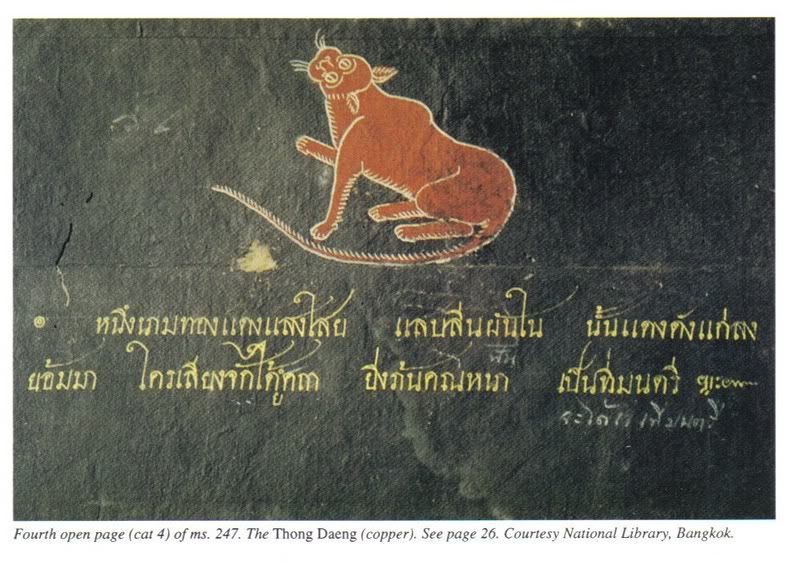
One copper, luminescent, claws, tongue and teeth as dyed red
Who raises it will gain great rank, a general or minister

One lao of flower of clear color, off-white fur, see black mixed
Who finds one, hurry to support it, that cat brings happiness
Women, men everywhere will cherish it, as this cat has charm
Loved all over by the people, both female and male

One called the jewel cat, of white body, with eyes like gems
Four black feet, ears and tail black as if ink applied
Has incalculable value, will bring great gain, more property
Who raises it will gain power, retainers and all good things

One a mercury color, a glowing shine, as if applied
Feed it well and great benefits rush in, raise it, do not doubt

One called Mongkol Amphai, the treatise says is auspicious
Black body, white neck round, good for the raiser, great wealth

One with a hourse-saddle mark, fine face with two black eye rings
Worth 100,000 gold tamleung, it brings its owner honour

One is black around the body, of great beauty, strange,
Who feeds it will have rank, power, with people fearing

One glows black all over, its nose clear white, a lovely face
Who raises, gains rank in seven months, the lords grant fortune

One with marks all over, its nose clear white, a lovely face
Who raises, gains rank in seven months, the lords grant fortune

One with marks all over, flashing beauty, strange,
Who feeds it will have rank, power, with people fearing

One glows black all over, its nose clear white, a lovely face
Who raises, gains rank in seven months, the lords grant fortune.

One with marks all over, flashing beauty, they say has dignity
Who raises, will be a minister, or chief of council, with rank

One marked large on mouth and nose, who finds it, should care for it
Will get land, fields, riches, a commoner becomes a master

One with underbelly markings is good for trade by boat
Merchants raise it hoping the cat is a bank of gold and silver

One has the line all along, good by the book, will further the family
With rank and power, replete, on an eternal base

One with amusing feet, they say to keep only for queen's lines
This cat brings virtue, so kindly do not endanger it

One marked on two ears, the treatise says should be raised by monks
For studying well, without forgetting with success as desired

They repeat in the books, one must study, raise and all will follow
Even in death, never discard the ghost, bury it, and keep the bones
In a pot to keep, which is also a virtuous act
When keeping do not despise it, or hit it, but care for it with love
Give it fine food, rice and fish, service it with everything replete
The cat will prosper, do not fret, or doubt the text

There are many more bad cats with tiger patterns,
They eat their young and have still births
Red tail markings of loss, twisted white tails, they say let go.

Here endeth the cat treatise, the bad and good in summary.


This particular poem didn't give the names of most of the cats, but other texts name 17 auspicious cats and 6 kinds of bad cats.

Just to show their poetic names, the 17 are: Ninlarat (Dark Sapphire), Wilat (Beauty), Suphalak(Excellent) or Thong Daeng (Copper), Kao Taem (Nine Points), Maaleht (Flower) or Dork Lao (Lao Flower), Saem Sawet (Alternate White), Ratanakamphol (Jewelled Cloth), Wichien Maas (Moon Diamond), Ninlajak (Sapphire Circle), Mulila, Krop Waen (Spectacle Frame) or Aan Maa (Horse Saddle), Pat-sawe (White Line) or Pattalort (Line Throughout), Krajork (Sparrow), Singha Sep (Lion), Karawek (Bird of Paradise), Jatubot (Four Feet), Konjaa (Sarus Crane)

Even the bad have exotic names. Six bad cats: Tupphalaphet (Weakness), Phan Phayak or Lai Sewa (Tiger Breed), Pisaat (Fiend), Hin Thot (Bad Stone), Korp Phleng (Fire Raiser), Nep Saniat (Dagger)

I wonder how these verses were used. Unless you were a cat breeder there isn't much use. I don't think cat breeding could have been such an important job (even if you could sell one cat for 100,000 gold pieces), but the survival of these texts certainly means that there was an abundance of them. An abundance of texts, but because of the nature of medium they were preserved in, never as ubiquitous as books in the west, and so Thailand was more of an oral society and a literate one.

These cat poems needed to be shared by being read aloud. I think they could have been tools for young students to learn how to memorize (and eventually read and write) since these cat poems didn't serve any practical purpose like buddhist texts or housebuilding manuscripts. They certainly are entertaining and the motivation of knowing your cats would be an incentive young ones to learn the verses.

6th October

A day many choose to forget. The recent military coup certainly helped refresh its memories. Here are some links about the anniversary of a very black day in Thai history.

Added Oct. 12, Chaiwat Satha-Anand's "Hurting, haunting, hoping", a deep articulation on how violence freezes time.
Former activists mark Oct 6 bloodbath
Democratic stance torn apart by coup
TRT figures fail to attend ceremony
Charoen honoured as an 'October 6 martyr'
Army 'never back in barracks'

And a page from "The Balancing Act: A History of Modern Thailand" by Joseph J. Wright Jr.
...and so a round-the-clock vigil began on the Thammasat campus. Though the university had been closed down earlier, 4,000 determined students broke through the gates and took over the Bo Tree Courtyard and the football field. There were reports later that some of these students had smuggled in firearms which, if it were true, would seem a precaution, wisely taken or not, against the kind of violence used by Red Gaurs against defenseless marchers in the anti-American demonstrations six months earlier.

While the four thousand sat cross-legged in clusters around the campus grounds, singing their protest songs and making speeches, the capital braced itself for a reprise of Fourteen October, the anniversary of which was now just 10 days off. Counter-demonstrations began right away. A group of 400 rightists protested outside the prime minister's office, on the fourth, demanding he take a definitive stand. They stayed through the night, and their angry shouts intensified the following day, 5 October, when he announced his cabinet changes. Seni had dismissed the conservative Samak from his post as a deputy in the interior ministry, and had placed the apparently neutral Admiral Sa-ngad Chaloryu at the head of Defense.

Meanwhile, at Thammasat, a troupe of students actors staged a pivotal drama, a reenactment of the lynching two weeks before of the union men who had protested Thanom's return. On a make-shift stage in the campus courtyard, a young actor was strung up on a harness to stimulate the hanging, while others portrayed those responsible for the deed. One of the performers-the one dangling from the rope- was said by some to have borne a certain resemblance to the crown prince, an unpopular figure then among the members of the left. Soon, somehow, word got out that the play had been an act of lese majeste, an insult to the crown, in which radical leftists had hanged the king's heir apparent in effigy.

By evening a photo story about the skit had made Bangkok's front pages. Dao Sayam-a "rabid, right-wing newspaper," says Anderson -printed apparently retouched pictures of the performers, exaggerating the features of the one in question to make him look more like the prince. Then, in what seems to have been a coordinated effort, the armed forces radio network broadcast a similar version of the story and urged the citizenry to buy Dao Sayam and see for themselves.

Considering the theme of the student's skit-the murder of innocent citizen by corrupt authorities- it does not seem logical that the dramatists would have planned to make the victim, who was a sympathetic figure, look like the crown prince. In another photograph of the skit, one sees a young man in the guise of a monk - apparently Thanom- seated half-lotus style beneath the dangling "corpse". In the monk's lap is a human skull; standing guard beside him is a soldier with a Nazi arm band. Several students lay about, face-down, nearby, obviously mimicking more dead bodies, those who had fallen on fourteen October. A placard beside the tableau reads "Students, don't worry. I only want a few more corpses."

Plainly, then, the hanging figure would not have intentionally resembled the prince. It simply would not have fit in with the rest of the scene if it had.

Yet, even if this was an act of mockery against the sacred institution of the throne, it would not have justified what followed. Heeding the call of the army broadcast for "all true Thai patriots" to quash the supposed anti-monarchist demonstrations, thousands of militants, led by the Red Gaurs and other neo-fascist groups, flowed into the Thammasat area and surrounded the campus.

It was now the morning of Six October, another date which requires no mention of the year to distinguish its place in Thai history.

Perhaps sensing what was to come, the NSCT (National Student Center of Thailand) leadership left the campus, not in flight but to surrender themselves to the prime minister and try to explain the true meaning of the play before the misguided mob could carry out its intentions. The NSCT leaders left behind some two-thousand of their fellow demonstrations who had spent the night on campus as promised. By the time the students leaders arrived at Seni's office, however, it was too late.

Claiming they had been fired upon from inside the campus, police who had been shepherded the mob outside called for reinforcements. By 7:30 am the streets outside the university compound were lined by special units of the police and military, armed with machine guns, recoilless rifles, grenade and rocket launchers. The mob had by now swollen to ten thousand, and as if the police needed more help, had armed themselves with swords, clubs, and guns of their own. Suddenly police and soldiers opened fire, pouring as many as 1,000 rounds per minute in sporadic intervals into the compound. They used no tear gas. By comparison, shooting a fly with an elephant gun seemed reasonable.

They smashed through the campus gates with a dump truck and charged the cowering demonstrators inside. There must have been snipers within firing upon the invaders, as photographs do show armed soldiers and policemen hiding behind trees and walls as the civilian mob carelessly blundered through the compound. But whatever armament the students possessed could not have been enough to make a difference, for soon the demonstrators were overcome by the rabble, some trying to flee, leaping into the Chao phraya River, others trying to give themselves up. Reporter Richard Nations was there.

"I saw one university student emerge from the auditorium unarmed only to be swamped by the mob and kicked and beaten to death with bottles, mangled chairs and jagged bits of metal torn from the main gates. Other students who tried to escape were hanged from the trees outside the campus. Later, their bodies were doused in petrol and burned. At least one girl was reported to have drowned among the many who tried to swim across the river to safety."

The rampage went on for hours, as police went from building to building to flush out the students. Once outside, the demonstrators were rounded up and herded into the football field where onlookers cheered from the bleachers, waving flags, and laughing as boys and girls alike were made to strip to the waist and lie facedown on the playing field; any show of reluctance earned a rifle butt in the head. Among the sprawling mass of half-clad students, prone and paralyzed with fear, strolled policemen, kicking and beating the quivering forms as they went. At least one officer went about stripping students of any Buddha images, violently ripping chains from around their necks; he said he did so "because communists are not Buddhists," but he did not mention the amulet's gold content.

By midday, police arrested 1,700 students and carted them away to detention facilities, driving them along the way, past the mutilated corpses of their friends, strung from the trees around Sanam Luang. Their job at Thammasat done, the victorious patriots marched to government house to confront the premier.

"I did my best," a tearful Seni Pramoj told the crowd. "I tried to keep law and order in this kingdom, but if you wish, I will go."

Somehow the honor and prestige of governing the people of Thailand did not seem worth fighting over now. A dark and ugly side of a normally pleasant people had just been revealed, and the Thai elite seemed revolted by it. That evening it was announced that the military had taken over the government. No one else seemed to want it anymore.

Siamese cats and old manuscripts


If you didn't already guess, I must warn you I am a cat lover. My previous post about Ms. Pook prompted me to work on this post about cats in ancient thai manuscripts, a post I intended to write a few years back but got sidetracked by life.

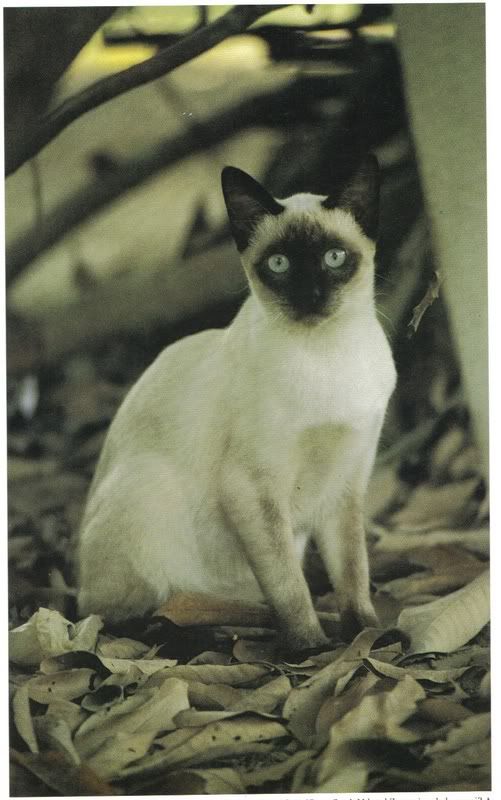
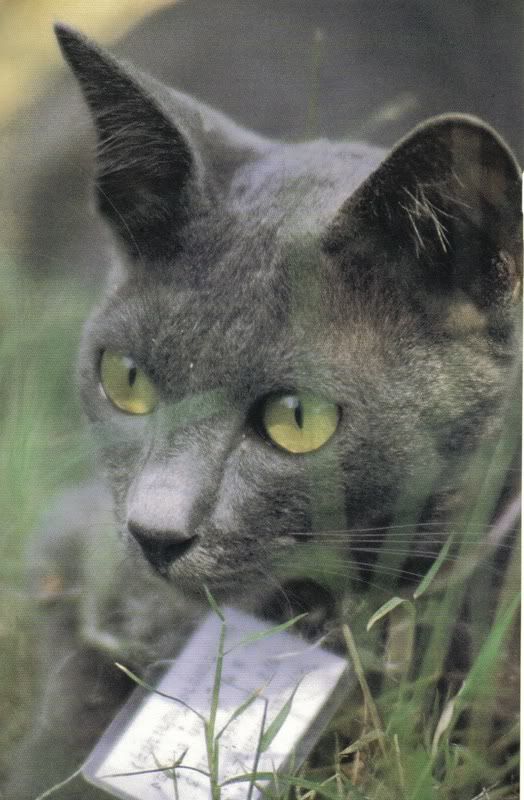
The pictures posted here are scanned from "The Legend of Siamese Cats" written by Martin R. Clutterbuck, printed by White Lotus Press (my favorite publisher). I was quite amused to find, when I googled for the book, that it was being offered for $1,711 at amazon.com. It seems that this book I bought in 1998 has become a rare and out of print book. (I've got to remember to never give up any of my White Lotus books.)

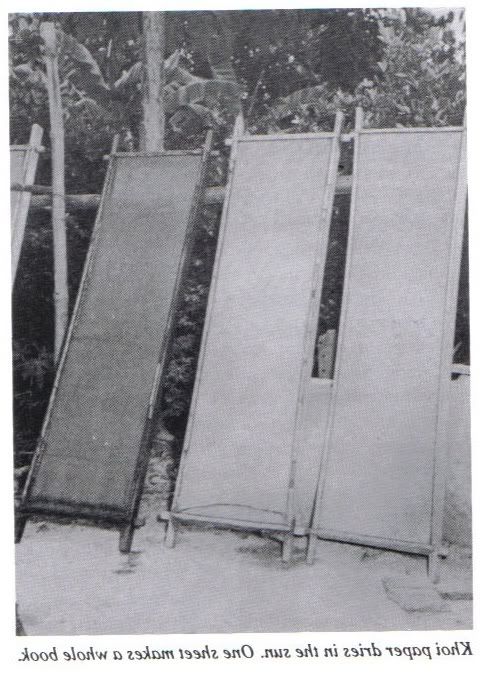
"Tamra Maew" (cat treatise or cat poems) were found in old thai manuscripts known as "smut khoi", rice paper books. The ones M. Clutterbuck used for his research were between 100-200 years old. However, research I've done previously on ancient literature revealed that manuscripts were copied by hand and passed down generation by generation in the family. They may date much older than those 100-200 years old. Another popular form of preserving ancient literature was with palm leaf manuscripts in which most buddhist literature is preserved. These are also copied by hand, and are said to last 600-700 years with correct preservation.


Some pictures from original khoi manuscripts can be found in the "Smud Khoi of cats from khoratworld.com where you can find info about the khorat cats.

The studies done wtih tamra maew reveal that these cat poems flourished from at least the 17th century. The first Siamese cats travelled to Europe around the 1860s when cat shows in Victorian England were already popular. The Siamese color-pointed, good humored, "talkative" and intelligent cat was an instant hit.

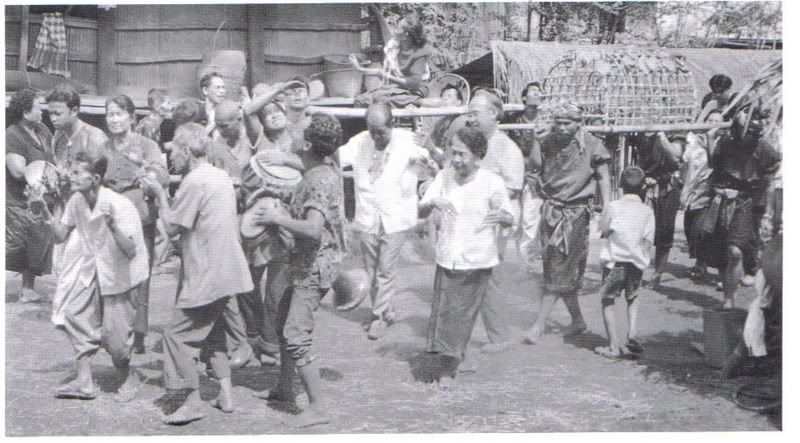
In Thailand, or rather Siam in those days, the (brown pointed) siamese cat was only one of a group of designated "auspicious" and lucky cats to have around for cat fanciers. King Chulalongkorn himself searched out cats with good appearances. The Korat cat, also known as "Si-sawat" was named "Korat" when King Chulalongkorn found them in this new region. In that newly annexed Northeastern region, there was a rain calling ceremony where a cat in a bamboo cage was paraded through the village, sprinkled with water and then set free.


I witnessed one such ceremony as a teenager visiting the Boon Bang Fai festival in Yasothorn in the early 80s. The "bang fai" or sky rockets, also a rain calling ritual, was already attracting more attention than the cat parade at that time. I don't think any villages perform the cat parade ritual anymore.
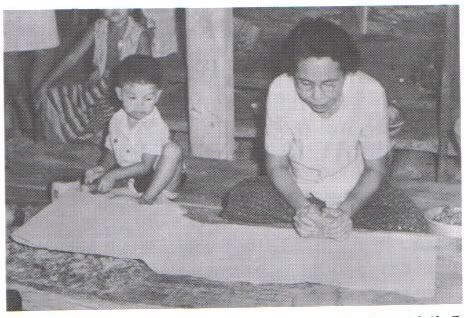
The samut khoi are made from the pulp of the khoi tree (streblus asper). This small shrub grows easily in the boggy and well-watered fruit plantations of Thailand's central plains. The stripped bark is pounded into pulp with wooden mallets: this is then poured over a wire mesh and dried in the sun. The resulting sheet is removed from the mesh and polished with stones before being folded concertina fashion to create a whole book from a single sheet. Nowadays, they are produced as luxury paper for soveneir making and exports.

The sheet can be blackened with the charcoal of the sanoh khang khok tree to create the black "samut thai dam". If bleached with lime in the pulping process a white "samut thai khao" is produced. The black books were written on with a pastel-like white pencil, which is usually written over with yellow ink made from gambage for permanence. The white books were written on with black ink. Chiangmai-chiangrai.com has a short page about the making of khoi paper books.

Chiangmai Mail, the first English language newspaper from Chiangmai, has an interview with Mr. Ed Rose who is a cat lover and became well-known for the numerous siamese cats he takes care of.

Prestwick-Beresford Old-Style Siamese
Breed Preservation Society
has a page on history of siamese cat breeding in US.

Coming up next will be one of the cat poems.

Wednesday, October 4, 2006

Self-sufficiency or sustainable development


The concept of what's being called "self-sufficient economy" in Thailand has been getting quite a bit of attention since the Thai coup leaders have declared that would be their economic policy. For people unfamiliar with Thailand's development, it might be a bit of a surprise and maybe difficult to understand. However, it's a concept that's been widely talked about and implemented as far back as in the late 70s-early 80s, even predating the Brundtland Report's definition of "sustainable development":
«Sustainable development is development that meets the needs of the present without compromising the ability of future generations to meet their own needs.»
Thailand's economic development has been guided by several 5 year period development plans of which there have been nine, summaries of the nine plans (1961-2006) provided here.

The first Western economist who had some understanding of how such a concept of development may work was E.F. Schumacher, and he wrote a famous book "Small is Beautiful: A study of economics as if people mattered". His concept has gained some ground in the world of conflicting economics and has been called Schumacher's Buddhist Economics.

However, don't mistake that for what the Thais are thinking about. Ven. P. A. Payutto's Buddhist Economics may be closer.

Among the economist in Thailand (at least my generation), the name "Father of Economics" in Thailand was given to Puey Ungpakorn, his simple piece "The quality of Life from Womb to Tomb" is a well quoted piece. He was among the key group of people thinking about the future of Thailand in the 30s. Puey was interested in development economics, however, economics taught in Thai universities had a very Keynesian tilt.

Theory explained, the actual implementation of such thinking was actually started in small scales through Projects Undertaken Through the Initiative of HM King Bhumibhol

Seventy years afterwards, this thinking crystalized and rises to the surface. It is printed in Chaipattana Foundation Journal HM's concept of self-sufficient economy:

His Majesty graciously granted his advice on self-sufficient economy in order for the people to lead their lives productively, peacefully and happily, with dharma to help steer the course and heart as an essential driving element. By Maintaining a Balance in the Five Following Aspects Describes the Principle of Being Self-reliant:

A balance in the state of mind: one needs to be strong, self-reliant, compassionate and flexible. Besides, one should possess a good conscience and place public interests on a higher priority, above one's own.

A balance in social affairs: people need to help each other, strengthen the community, maintain unity, and develop a learning process that stems from a stable and strong foundation.

A balance in managing natural resources and the environment: the country's resources need to be used efficiently and carefully, in order to create sustainable benefits and to develop the nation's stability progressively.

A balance in technology: technology should be used appropriately while encouraging new developments to come from the villagers' local wisdom.

A balance in economic affairs: one needs to increase earnings, to reduce expenses, and to pursue a decent life.
He proposed pratical method for farmers, the 30:30:30:10 ratio of land use which work under the three following phases.

Phase 1: To live at a self-sufficient level which allows farmers to become self-reliant and maintain their living on a frugal basis.
Phase 2: To cooperate as a group in order to handle the production, marketing, management, and educational welfare, as well as social development.
Phase 3: To build up connections within various occupation groups and to expand businesses through cooperation with the private sector, NGOs and the government, in order to assist the farmers in the areas of investment, marketing, production, management and information management.
Finally,
To Live in Accordance with the Principles of Self-sufficient Economy

1. One must adhere to a frugal style of living and try to cut down daily expenses especially for extravagant items as stated in the Royal speech, ". . .One should not live luxuriously and must cut down expenses in an appropriate manner. . ."

2. One must be true to oneself and work righteously as well as honestly, even under harsh living conditions according to the Royal speech, ". . .Success of all people comes from good conduct and proper work. . ."

3. One must stop selfish competition and the habit of taking advantage of others when doing business as commonly happened in the past. This is defined in the following excerpt from the Royal speech, ". . .The meaning of genuine happiness is the happiness derived from one's fair conduct, both of intention and action, and not from coincidence or taking advantage of others. . ."

4. One must not give up in finding ways to pull oneself out of hardship, by striving to learn more and more in order to earn sufficient income, as stated in the Royal speech, ". . .The reason for encouraging people to learn more and become stable in their life is for their own lasting happiness from, first, leading a sufficient lifestyle, and then from being proud of themselves for being able to stand on their own. . ."

5. One must behave with good morality and refrain from all greeds. Thai society collapsed with this adverse economic situation because a lot of people betrayed their own country without any shame. His Majesty the King graciously delivered a Royal speech that conveys a similar message, as follows: ". . .Avoid committing wrongdoings that will destroy oneself or others, eliminate one's inner greed, remain true to oneself, as well as preserve and enhance the good virtues within oneself. . ."

Chaipattana ends the article with, "His Majesty accentuated that the most important word is "sufficient". If we are satisfied with living at a sufficient level which is reasonable for our status, we will then learn the true meaning of happiness."

"My Cat, Pook, and 6 Oct"

This short story by Wattanchai Winichakul @OnOpen.com, written in very correct and poetic Thai, touched me in its simplicity and depth, so I decided to translate it for English readers. The English, of course, would never equal the Thai version in its communication. So if you can read Thai, please read the Thai version, link provided above.
"Miss Pook" was my pet cat when I was a child.

Ms. Pook's fur was three colored, mostly black, white with patches of yellow all over her body up to her tail. Her four paws were all equally white. Most prominent of all, was her face, exactly halved by fur of black and the other half, fur of yellow.

At that time, my house was a food shop in the Ta Prachan area. Therefore, Ms. Pook grew up well fed. She was a teen cat with shiny fur, playful and mischievous. She could be classified as a good natured cat with extraordinary intelligence for a cat.

There was this time when I taught her how to use the toilet bowl by carrying her with me to the bowl and showing her by doing the business myself. Since then she would pee in the toilet bowl and patiently wait for someone to come flush it down with water.

Ms. Pook lived a very common cat life. We would rarely see her catch a rat. If she did, she was just following her cat's instincts. Once she caught and killed a rat, she would play with it rather than eat it because she was already well fed.

My Ahmah loved cats. She would have fresh platoo (thai fish) in the fridge ready to mix with rice for Ms. Pook to eat every morning and evening. Ahmah would call Ms. Pook to eat by knocking the aluminium bowl on the floor. Its sound, a few "peng! peng!" would miraculously produce Ms. Pook from whichever corner she was hiding in to faithfully appear immediately in front of that bowl.

On the morning of 6th October, BE 2519, I got up as usual to shower and get ready to go to school but found that the shop was not open. My older brothers told me that I didn't have to go to school because there was a violent situation at Thammasart University. I was secretly happy to not go to school, but a little bit sad because I wasn't able to send my art homework on which I had deligently colored during the whole week.

At 7:00 am, a thunderous sound, as if something gigantic fell right next to my house startled and frightened me. We had become accustomed to the sound of guns and bullets because our house was located close to Thammasart and Sanamluang, a strategic location during that time.

This incredulous sound was not like before. I felt as if great danger was falling upon us. Ms. Pook was all puffed up, hair on ends, running around like mad, her eyes filled with terror I had never seen before. Ahmah tried to catch her but couldn't. We didn't know which part of the house she went to hide. That was the moment when many occurrences took place in my house.

Many strangers came into our house and were herded away.

My elder sister nearly got taken away in the herd, fortunately, my mother managed to pull her back.

Many uniformed men came into my house and ransacked the house, rudely shouting at my mother's and father's faces.

One of my older brothers got hit in the back of his neck with a riffle end when he moved towards the door to answer a frantic knock on the door. He was dragged out in front of my mother and father. After that I heard the sound of a round of machine gun. My elder sister fainted. My mother's heart shattered.

My aunt had a house in Pratoonam. She sent her daughter for us to take refuge there.

"Go and help bring the kids and the elders. If you can't help them out, then don't come back!", my mother recounted my aunt's orders.

My brothers and sisters, my mother, and myself, altogether five of us took refuge at Pratoonam for nearly a month. When we returned to our Taprachan home, I found that my father had taken Ms. Pook away to some place where she wouldn't find her way home. My heart ached, it reflected the terrible atmosphere in our family at that time.

Sadness remained in my heart for some time, but one day my brothers voices woke me up calling me to come look at something. I sleepily walked downstairs and saw there Ms. Pook looking at me with wide eyes, her fur all dirty and mangly. I called her name and ran down to hug her to myself with joy, but there were no more tears. They had dried up since the morning after October 6.

They say that cats loved the house, dogs loved their owners. So if a cat ever got lost or deserted, it would always find a way home, just as Ms. Pook did.

I wanted to ask her, where had she been, how difficult had it been, what did she encounter? All I could do was to pet her all over and rub her chin as she liked. If she could talk she would probably have asked me, and you, how were you when I was gone, did you think of me? But all she could do was to nudge my hand and try to wrap herself around my legs.

Ms. Pook came back to live her happy normal life with us. Many times, when I returned home from school, I would find her languidly sunbathing under the evening sun shining in through the windows. Her shiny black fur sofly reflecting the light would always invite me to go pet her and give her a rub under her chin.

I don't know if Ms. Pook remembers any of the trauma of October 6. I believe that if she can be so intelligent to do many things beyond normal cats, she would remember all the good and bad things that have happened no less than my own memories.

Only different from us...

Human memory is a wound cut deep in the heart,

Never forgotten.

PS. I got particularly weepy for this one because my cat of 12 years old recently died. I think all Thais are apprehensive and sad that this year's anniversary of 16 Oct is under a military coup regime.

Picture of my cat.

Migrant labor

BKK Post, Oct 4, 2006 reports "Thai workers 'cheated in Qatar'".

This is an issue that boils under the surface of everyday Thai politics and policy making, pops up once a while with a scandal such as the one above and eventually gets eclisped by other issues while its problems remains mostly unsolved.

A good brief about the problem is found here, it starts...
"Since 1973, Thai workers have migrated to Middle Eastern countries such as Saudi Arabia, Iraq, Kuwait, United Arab Emirates, Bahrain and Qatar. Saudi Arabia was once the largest labor market for Thai workers. In 1990, following a diplomatic break between the two countries, there was a sudden reduction in the demand for Thai labor. Thai migrant workers had to turn to the job markets in Southeast Asia (Singapore, Malaysia, Brunei) and East Asia (Japan, Taiwan, South Korea and Hong Kong). As of 1995, an estimated 627,815 documented and undocumented Thai migrant workers were scattered around the world."

Source: A White Paper from pacific.net

The first labor policy was initiated in 1932.

Sample of a "labor campagin" here)

Migrant labor policy is pretty closely related to Thai politics. (What a remarkable synchronicity that the BKK Post makes the above report at the dawn of this government.) It was part of a campaign introduced in the 70s by some power dealers, gained bureacratic support and henceforth grew. It was at the same time partly, an emergence from the periphery, as cash strapped Isaan workers tried whatever they could to find a living. This was easy money for them but it has put them in cycles of debt-ridden woe and loss of property rights. Even if a new Ministry of Labor has been set up in 1993, the issue has been eclipsed by other more politically volatile issues of the increasing import of poorer migrant workers into Thailand. So the poor people from the Thai countryside are still more or less left on their own wits to deal with the sharks and snakes of labor agents in their hopes of hitting the jackpot.

There's an interesting description here, where it gives an explaination about how migrant workers or "tourist consumers" are tied to "traditional forms of Buddhist ceremonial" where
"More than just a welcome respite from the drudgery and discipline of factory jobs, these excursions allow labor migrants to make important claims about their experiences as members of the Thai nation-state. As tourist-consumers, migrant workers appropriate powerful signs and symbols of modern Thai identity and status; in so doing they contest (and at least partly rework) their material and ideological marginalization within contemporary Thai society."

Lastly, a succinct blog post by David Frazier from Taiwan, in "Pots: "Thai Labor: Widgets or Workers"

Tuesday, October 3, 2006

More on pyramid of party politics

Posters and polling, two business that grew greatly with party politics.

BKK Post's COUP DEALS BIG BLOW TO POSTER MAKERS by SURASAK TUMCHAROEN

and this one (Bangkokians prefer being happy, The Nation), I thought was a silly way to use a poll. Party politics, polling = dualities that we need to escape from.

Monday, October 2, 2006

Excerpts of Prime Ministerial Order No. 65/2525 "Plan for Political Offensive"

I found this is the appendix of Suchit Bunbongkarn's "The Military in Thai Politics, 1981-86", printed by ISEAS, 1987. This was a government paper signed by then Prime Minister Prem Tinasulanonda in 1982, so possibly a number of people were involved in its drafting. What I found interesting was how it categorized "pressure groups and interest groups" as "economic groups, the masses, progressive groups, and mass media". An extensive quote, but it needed all its elements together:

1. Principles and Rationale

1.1. Pursuant to the Prime Ministerial order No. 66/2523 of 23 April 1980 pertaining to the policy "Struggle to Win Over Communism" which required that the "Struggle to Win Over Communism be completed within a short period of time by conducting a continuous political offensive", the Cabinet on 20 April 1982 endorsed the recommendations put forward by the Committee on the Policy to Struggle to Win Over Communism concerning a "Plan for Political Offensive", and hereby ordered by Government agencies concerned to follow the guidelines laid out in this plan as well as other plans which the Committee may add in the future to complement it.

1.2. The important factor in the struggle to win over communism and destroy all forms of authoritarianism (totalitarianism) is the development of democracy. The people desire that the nation becomes democratic under the leadership of the monarchy, but because the political development towards democracy has been delayed and is full of shortcomings, the communists have used these conditions as the basis for a propaganda campaign to compete for the people's loyalty. However, the "democracy" spoken of by the communists is only a tactic to win over the state so that eventually a conversion can be made to socialism and communism. Therefore, better and true democracy, both strategically and tactically speaking, must be developed within a short period of time. The personnel who will be the main instrument for achieving this task, are to be government officials in every agency as well as ordinary people with idealism who are prepared to co-operate to bring about a model democracy in our society.

2. Objectives and Policy

2.1 To promote true faith and understanding that sovereignty rests with the people.

2.2 To create a balance between individual freedom and this collective sovereignty.

2.3 To destroy all forms of authoritarianism and form a democratic society under the leadership of the monarchy and based on the guidelines of democratic beliefs.

3. Operational Framework

An organizational unit composed of government officials and idealistic ordinary people as core members is to be created to direct the campaign. This unit is to be responsible for safeguarding the people's interests, creating true democracy and fulfilling the basic needs and desires of the people by:

3.1 Enabling the people to live in happiness and security, both personal and material, free from exploitation and repressive influences.

3.2 Enabling the people to live with honor and dignity, and to participate in and lead political processes, for they are the owners of the country.

3.3 Enabling the people to live with hope and faith in their faith in their future and their nation's security.

4.Operational Guidelines

4.1 The task of developing democracy has two parts: one is to promote faith and understanding that sovereignty rests with the people by destroying authoritarian power and influences from the local to the national level, and the other is to promote individual freedom by making laws which are laws. Due to the existence of many constraints such as resources and laws which must be amended or annulled, this task cannot be accomplished completely in a short period of time, but should be done in continuous stages with a full awareness of the special characteristics of Thai society and contextual limitations...

4.2 In addition to the operational guidelines laid down by Order 66/2533 of 23 April 1980, the following operational guidelines are to be followed:

4.2.1 Faith in the value of democracy... must be promoted by disseminating and improving knowledge of democracy both in theory and in application; providing true information about the prevailing situation; educating the mass media which are to act as an instrument for transmitting correct knowledge and understanding of democracy to the public at large; and ensuring that governmental officials conduct themselves in an exemplary and democratic manner.

4.2.2 The discharging of their respective responsibilities according to democratic principles by all state mechanisms must be accelerated at two levels. At the highest level of decision-making which involves politicians, political parties and top administrators... policies must be laid down clearly, positively and coherently to solve the nation's fundamental problems... strong and decisive response must be made to cope with day-to-day problems as they develop in accordance with principles of justice and interests of the people as a whole; opportunity must be made open for others such as academics, mass media, interest groups and various experts or specialists to partake in solving of such problems... The bureaucracy as a whole must be improved to strengthen the conditions for creating and developing democracy, and bureaucrats must be made to develop a conscience and sense of duty together which idealism to be responsive to the people in a responsible way, strictly to enforce the law and bring justice for one and all... At the level of civil servants, improvements must be accelerated because all civil servants, have an important role in putting into practice the national policy but at the moment are still lacking in the sense of duty and idealism necessary to promote popular sovereignty and generate respect for the law. All civil servants are to ... search for sources of a remedy for corruption ... discharge their duties and responsibilities strictly ... and within limits ... prevent fellow civil servants from acting as lords and masters of the people and exploiting them, and at the same time bring to justice those who break rules... (In addition) the bureaucratic system must be reformed and decentralized, delegating power and responsibility towards regions and localities..., and sufficient salary and welfare must be provided for all civil servants, especially those at junior levels, so they can uphold their own honor and dignity.

4.2.3 Popular participation in political activities must be promoted to enable the people to have more practicle experience which can serve to strengthen their attachment to an understanding of the principles of popular sovereignty. This must be done by involving the people in activities near their places of residence such as in the tambol councils, village committees and co-operatives ...; encouraging the use of political parties as a means of promoting their own interests at the national or local level in accordance with the principles of democracy...

4.2.4 Activities of pressure groups and interest groups must be regulated. Pressure and interest groups can act either to reinforce or to obstruct the development of democracy. Therefore, to ensure that their role be a constructive one and to deter any such group from hindering this development, their activities must be regulated in the following ways:

Economic Groups Because Thailand has a liberal economic system but its state mechanisms for mobilizing resources and distributing benefits are still weak, some economic groups have been able to take advantage to build up monopolistic power which inflicts social injustice and material hardship on the people, creating conditions for war. Moreover, some of these monopolistic groups have been able to develop great political bargaining power which is an obstacle in the development of democracy. Although it is vital to regulate these groups, the process of regulating them should be taken step by step and in accordance with the law ... The guidelines for cutting down the monopolistic power of the economic groups are: accelerated enforcement of the law against any violation by business; use of strict legal measures to guard against any violation by business; use of strict legal measures to guard against and destroy monopolistic power; enhancing among traders and capitalists the feeling of social responsibility and commitment towards the collective interest of the nation, by commending those with a social conscience, education, and opening up opportunities for participation in solving problems caused by their peers, and use of appropriate monetary, fiscal, legal and administrative measures on business, industry and commerce to bring about a distribution of economic benefits among the people at large.

The Masses. Workers and farmers are important in that they form the crucial foundation for Thailand's revolution and are targets for competition among political groups including the communists. Therefore, to prevent opposition groups from winning over them, to save them from being victims of communist propaganda and to generate their support for the development of democracy, the following guidelines for action should be taken. Support should be given to mass organizations which are truly democratic to prevent their leadership from falling into the hands of opposition groups. Leadership of mass organizations should be won over to destroy the subversive power of the communists within these organizations. A political environment conducive to mass political activities based on the principles of democracy should be created and encouraged.

Students. Students are a special group which has high political awareness and seeks democracy and social justice. However, because their experience is limited, they are targets for communist groups and used as a part of the united front constructed by the latter. Therefore, to utilize students as a force for democracy and to prevent them from becoming tactical tools of communists as well as other authoritarian groups, the following guidelines for action should be taken. Freedom should be given to students to conduct all their activities, including political activities, which are within the law and the regulations laid down by their academic institutions. Students' activities geared towards the development of democracy be incorporated in the syllabus at every level of education and appropriate textbooks prepared by academics as standard of references for the future.

Progressive Groups. There are now many groups which have become more politically active in urban areas, including those who have returned from the "jungle", various progressives, communists, united fronts and other democratic groups. To ensure that their activities be kept within bounds imposed by national security considerations and contribute towards the development of democracy, the following guidelines for action should be taken. Opportunities should be given to all groups to put forward ideas and suggestions within the limits of the Constitution and law. Strong democratic movements should be encouraged in accordance with the Prime Ministerial Order No. 66/2523 dated 23 April, 1980. Leadership of Progressive ideas should be won over. Activities of those groups which constitute a threat to national security and the development of democracy should be closely and continuously observed and obstructed.

Mass Media. The media can act either to promote or to destroy democracy. Therefore, to ensure that they are constructive for democracy, the following guidelines of action should be taken. Members of the mass media who have democratic ideas should be commended and given support and special responsibility in providing new conducive to the development of democracy encouraged. Campaigns to use ideas as a means of promoting democracy by the mass media should be supported. The government's mass media organizations should be used to promote democracy and counteract news which cause its destruction. News which have adverse impact on the democratic system should be curtailed by executive as well as legal measures.

Armed Forces and Formation. They should have a correct understating of democracy and support and preserve this system.

27 May BE 2525
(27 May 1982)

(Signed) General Prem Tinsulanond
Prime Minister

The source quoted for this plan wasISIS Bulletin.